
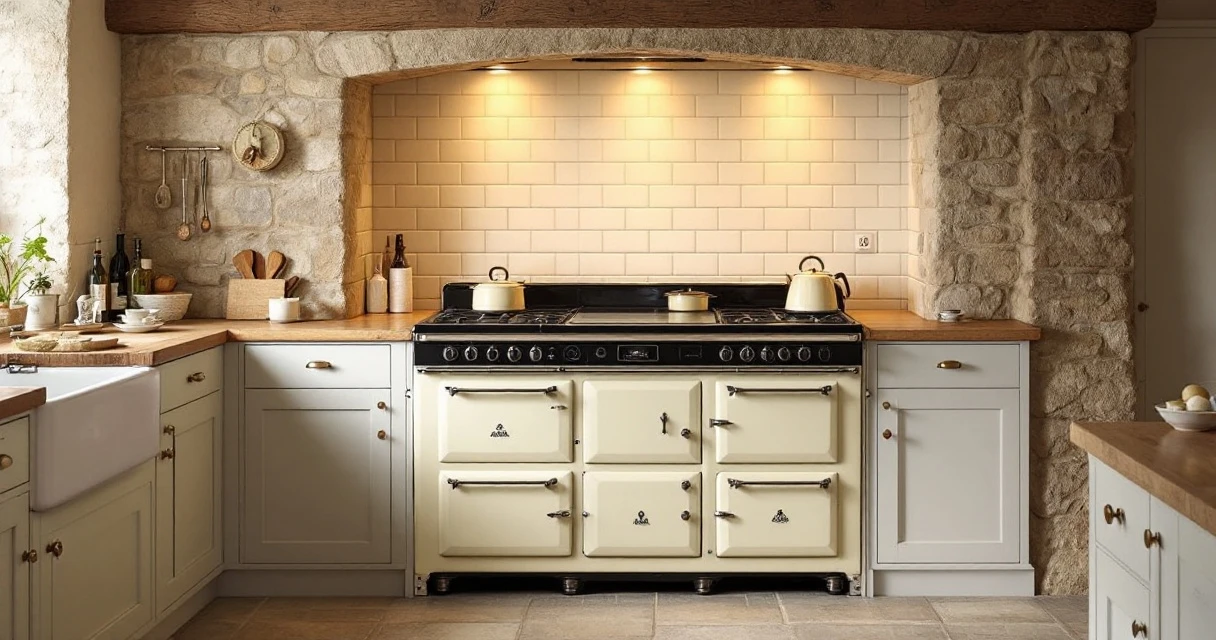
If you have moved to a rural property in Devon — particularly in the Tavistock area, the Tamar Valley, or on the Dartmoor fringe — there is a reasonable chance you have inherited a Rayburn. These range cookers are a fixture of West Devon and east Cornwall farmhouses, and they are quite different from anything you will find in a town property.
What Is a Rayburn?
A Rayburn is a range cooker manufactured by Aga Rangemaster that provides three functions from a single appliance: cooking, central heating, and domestic hot water. Like an AGA, it runs continuously rather than being turned on and off. It heats up from a central flue and distributes warmth throughout the property via a central heating circuit.
Rayburns can run on oil (most common in Devon), LPG, natural gas, or solid fuel (wood or coal). Oil models — which use a Wallflame or pressure jet burner — are by far the most common in rural Devon where mains gas is not available.
Fuel Types: Which Is Most Common in Devon?
Oil Rayburns are the dominant type across rural Devon and east Cornwall. They burn 28-second heating oil (the same fuel as domestic oil boilers), delivered by tanker and stored in an oil tank, usually at the side of a barn or outbuilding. Oil Rayburns use either a Wallflame burner (an older, quieter design common in models from the 1960s to 1990s) or a pressure jet burner (more common in later models and more efficient but noisier). All oil Rayburn work must be carried out by an OFTEC-registered engineer.
LPG Rayburns are found in properties without mains gas or an oil tank, typically using a large LPG cylinder or a small buried tank. LPG is more expensive per kWh than oil but more convenient if the alternative is installing a 1,000-litre oil tank.
Solid fuel Rayburns are the oldest type and still found in some historic Devon farmhouses. These burn wood or coal and require daily attention — loading, ash removal, and flue checking. They have no automatic controls. Running costs can be low if you have access to timber, but they are labour-intensive.
Why Rayburns Are Common in This Area
Much of the housing in the Tavistock area was built before mains gas arrived in Devon — and some rural properties have never had it at all. A Rayburn was, for generations, the practical solution: one appliance that cooks and heats the whole property from a single oil tank in the yard.
The running cost of a Rayburn on oil is higher than a modern condensing boiler, but the warmth they create — particularly the ambient radiant heat in the kitchen — is something many Devon homeowners value. Many rural properties would require significant modification to install a conventional boiler heating system, making the Rayburn the right long-term choice even today.
Running Costs: Rayburn vs Modern Condensing Boiler
This is the most common question from people inheriting a Rayburn. The honest answer: a Rayburn on oil is more expensive to run than a modern A-rated condensing gas boiler, but often comparable to or cheaper than an older oil boiler system, because the Rayburn provides cooking alongside heating and hot water.
A typical oil Rayburn uses around 3,000–4,500 litres of oil per year for a medium-sized Devon farmhouse. At current prices (around 75–85p per litre in Devon in 2026), that is £2,250–£3,825 annually. A modern condensing oil boiler for the same house would typically use 1,800–2,500 litres for heating and hot water, saving on fuel — but you would still need to run a separate range cooker.
The full comparison depends on how much you value the cooking function, the ambient kitchen warmth, and the simplicity of one appliance versus two. Many Devon homeowners with working, well-serviced Rayburns find the overall economics are reasonable when all three functions are included.
Annual Servicing
Rayburns require annual servicing. During a Rayburn service, an engineer will:
- Check and clean the burner and combustion chamber
- Inspect the flue and ensure the draw is correct
- Measure combustion efficiency
- Check the heat exchanger for leaks or deterioration
- Test all safety controls
- Advise on any parts showing wear
Without annual servicing, efficiency drops steadily, fuel consumption rises, and the risk of burner failure or flue problems increases. A well-maintained Rayburn will typically last 30-40 years. A neglected one may fail within 15.
Common Rayburn Faults and What They Mean
Burner won't light or keeps cutting out. The most common cause is a dirty or worn burner nozzle. In pressure jet models, the nozzle atomises the oil into a fine spray — when it becomes partly blocked, combustion is incomplete and the boiler locks out. A service resolves this. If locking out becomes frequent between services, the nozzle may need replacing sooner than the annual cycle.
Reduced heat output. If the Rayburn feels less hot than usual and fuel consumption has not dropped, the heat exchanger may be accumulating scale or soot deposits. This is resolved during the annual service, but if it develops between services, it usually indicates the combustion settings need adjustment.
Flue drawing poorly. In Devon's older farmhouses, flue problems are often caused by debris accumulation (particularly in autumn when birds can nest in unused flues), deteriorated flue liner, or — in unusual cases — the flue being overshaded by a new extension or tree growth that changes the airflow. A heating engineer can assess this.
Oil smell. Any oil smell from the Rayburn area should be investigated. It can indicate a leaking oil line, a faulty burner seal, or incomplete combustion. Do not ignore an oil smell.
When to Replace Rather Than Service
A Rayburn that has been well maintained can serve a Devon property for decades. The signs that replacement is becoming the better option:
- Heat exchanger cracked or leaking (often the most expensive single repair)
- Repeated burner failures in a short period, indicating the burner assembly is worn out
- The Rayburn is pre-1980 and has never been upgraded — older models are significantly less efficient and spare parts are becoming scarce
- You are converting the property to a different heating system (mains gas connection, heat pump) and the Rayburn will no longer be the primary heat source
For replacement, contact the AGA Rangemaster service network or a heating engineer with Rayburn experience. We can advise on whether to replace like-for-like or transition to a conventional oil boiler system.
Who Services Rayburns in Tavistock?
This is a genuine gap in the local market. Chamings Plumbing — the main incumbent Tavistock plumber — has a Rayburn page and attracts around 10 visits per month for it. Beyond that, there is very little local provision.
We service Rayburns and AGAs across the Tavistock area and rural Devon, including remote farms and properties on Dartmoor National Park where access requires forward planning. If you have a Rayburn that is overdue for service, or one that is running inefficiently, request a quote online.